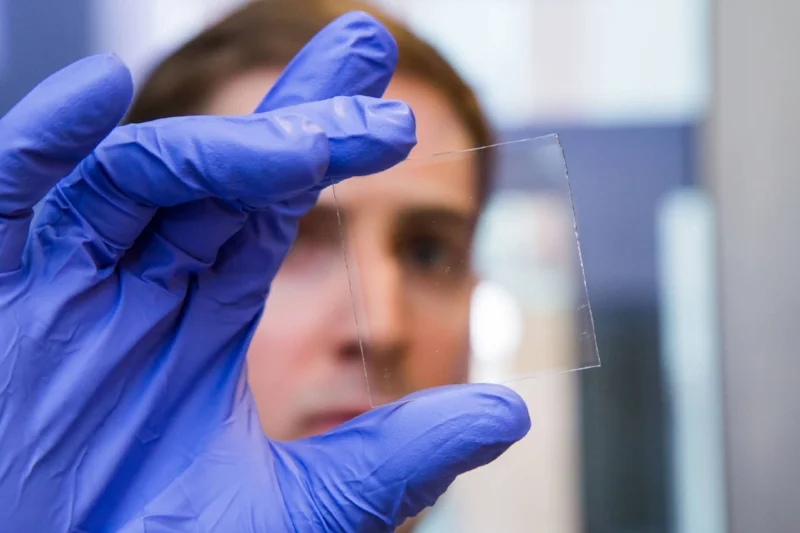
Self-powered system makes smart windows smarter - Princeton University
These smart windows require power for operation, so they are relatively complicated to install in existing buildings. But by applying a new solar cell technology, researchers at Princeton University have developed a different type of smart window: a self-powered version that promises to be inexpensive and easy to apply to existing windows. This system features solar cells that selectively absorb near-ultraviolet (near-UV) light, so the new windows are completely self-powered.
“Sunlight is a mixture of electromagnetic radiation made up of near-UV rays, visible light, and infrared energy, or heat,” said Yueh-Lin (Lynn) Loo, director of the Andlinger Center for Energy and the Environment, and the Theodora D. ’78 and William H. Walton III ’74 Professor in Engineering. “We wanted the smart window to dynamically control the amount of natural light and heat that can come inside, saving on energy cost and making the space more comfortable.”